How the migration moves through the Serengeti and the Masai Mara, when the herds are usually in Kenya, and how to plan without false promises.
Each year, well over a million wildebeest, together with large numbers of zebra and gazelles, travel in a great circle through the Serengeti-Mara ecosystem in search of fresh grazing. In Kenya, the part of this journey that draws the most attention is the arrival of the herds in the Masai Mara and their crossings of the Mara River. This guide explains how the migration works and how to plan a visit around it, with realistic expectations.
What is the Great Migration?
The migration is not a single event but a year-round movement driven by rainfall and grass. The herds follow the rains across northern Tanzania and southern Kenya, and the route is roughly a clockwise loop. Because it depends on weather rather than a calendar, timings shift from year to year.
The yearly cycle in outline
January to March: calving in the south
The herds are usually on the short-grass plains of the southern Serengeti in Tanzania, where a large number of calves are born in a short period. Predators such as lions, cheetahs and hyenas follow the herds.
April to June: moving north
As the long rains end and the grass dries, the herds move north and west. In the western Serengeti, the Grumeti River is a first major obstacle for some of the animals.
July to October: the Mara
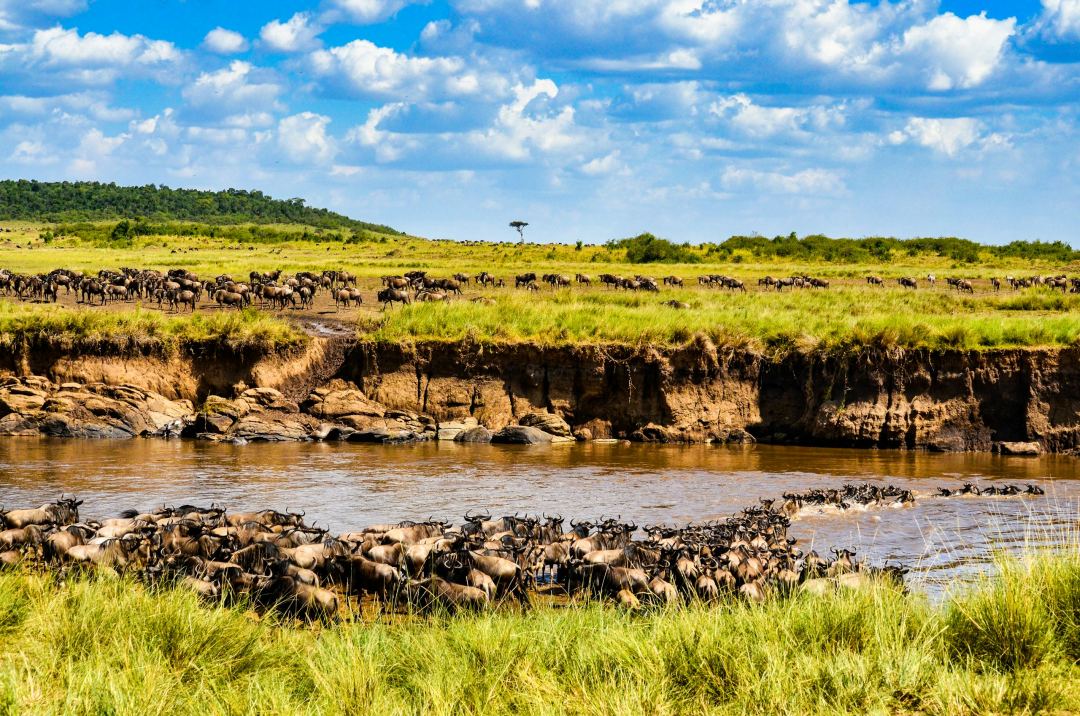
The herds reach the Mara River, which forms a natural barrier between the Serengeti and the Masai Mara. They usually enter Kenya between July and September, and remain until grazing in the north thins out. This is the period most visitors target.
November to December: heading back south
With the short rains, the herds return to Tanzania. Kenya becomes quieter, though resident wildlife remains plentiful.
Understanding river crossings
The Mara River crossings are the most dramatic part of the migration. Herds gather on the bank, sometimes for hours or days, before one animal leads and others follow. Crossings are unpredictable and can occur at several points along the river. Crocodiles live in the river, and the steep banks add danger for the animals.
Most visitors see herds on the move and large gatherings, but only some witness a full crossing. A good guide will position the vehicle based on the herd's behaviour and the day's conditions, but patience is as important as skill. Please be aware that responsible drivers keep a respectful distance and do not drive in front of the animals, because disturbing the herds can stop a crossing.
How to plan a migration safari
- Choose the right length. Allow at least three nights in the Mara to give yourself several chances to see a crossing.
- Book early. The migration period is the busiest time of year, and good camps fill up months ahead.
- Pick a base. Camps near the river reduce travel time. Conservancies and reserve camps both have benefits.
- Be flexible. If the herds are still in Tanzania when you arrive, there is still plenty to see, including big cats and resident herds.
Is a balloon flight worth adding?
A sunrise balloon flight gives a different perspective over the plains and can show herds from above. It is optional, weather dependent and costs extra. It is not essential to enjoying the migration.
What if you cannot travel between July and October?
You can still enjoy the Mara. Resident wildlife is present year-round, and the reserve is greener and less crowded in other months. Some travellers prefer the calving season in the southern Serengeti instead, which involves a Tanzanian itinerary. We can discuss extensions if you wish to combine both countries.
Respecting the wildlife
The migration depends on healthy ecosystems and the goodwill of local communities. Choose operators who follow park rules, stay on tracks where required and limit the number of vehicles at a sighting. This helps keep the experience special for the animals and for future visitors.
Next steps
Tell us when you hope to travel and what you most want to see, and we can recommend a route and a camp. We will give you an honest view of how likely you are to see herds and crossings in your dates, without promises that nobody can keep.